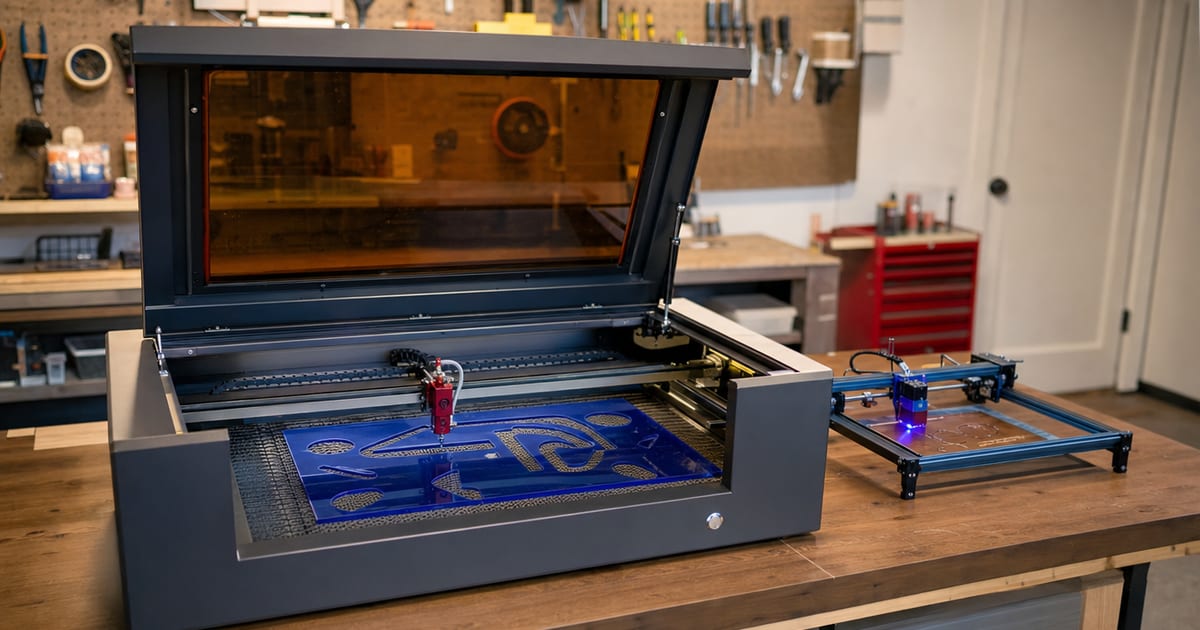
I run a diode laser and a desktop CO2 laser side by side in a converted single-car garage, and the question I get asked more than any other is some version of “which one should I buy?” The honest answer is that they’re not really competitors — they’re tools for different materials. Once you understand the material divide between them, the choice usually makes itself.
It comes down to wavelength
The whole difference starts with the colour of the light, even though you can’t see it.
- A diode laser emits at roughly 450 nanometres — blue light. It’s absorbed beautifully by dark, organic and coated surfaces, and it can be focused to a fine spot for crisp engraving.
- A CO2 laser emits at roughly 10.6 micrometres — far infrared. That wavelength is absorbed by a much wider range of materials, including ones a diode passes straight through.
That single difference is why my two machines live in completely different lanes.
What my diode is great at
My diode is my everyday machine for engraving and for cutting thin stock:
- Wood — engraves gorgeously and cuts thin plywood and hardwood given enough optical wattage and passes. This is its home turf.
- Leather — engraves and cuts well; one of my favourite materials on it.
- Dark or coated stock — slate, painted metal, anodised aluminium (which it marks, not cuts), powder-coated surfaces.
- Tumblers and coated metal — it marks coated drinkware nicely.
Where the diode hits a wall:
- Clear acrylic — it passes straight through. This is the exact mistake that started my whole laser journey. A diode will not cut clear acrylic, full stop.
- Bare shiny metal — the beam reflects off it rather than being absorbed, so a diode can’t cut bare metal (and marking bare metal needs a marking spray or a different machine entirely).
What only my CO2 will do
My CO2 is the cutter. It does the jobs the diode can’t:
- Acrylic — including clear acrylic, with clean flame-polished edges. This alone justifies a CO2 for a lot of makers.
- Thicker wood — it powers through stock that would take my diode many slow passes, if it managed at all.
- Leather, paper, card, fabric — cleanly and quickly across a big bed.
Where the CO2 also stops:
- Bare metal — a standard desktop CO2 doesn’t mark bare metal without a marking spray, and it won’t cut metal at hobby power levels. Cutting metal is fiber-laser territory, which is a different machine again.
Speed, bed size and the things beyond the beam
The wavelength divide is the headline, but two practical differences shape daily life with each machine. The first is speed and bed size. My desktop CO2 has a larger bed and powers through cuts fast, so when I’ve got a batch of acrylic ornaments to cut, it’s done in a fraction of the time the diode would take — if the diode could do it at all. My diode has a more modest work area and is slower on anything thick, but it’s nimble for small engraving jobs and one-offs. If you make a lot of the same cut item, bed size and cutting speed matter more than you’d guess from the spec sheet.
The second is cost and complexity. A diode is an affordable, fairly simple open-frame machine — fewer things to go wrong, cheaper to replace a module if you damage one. A CO2 has a glass laser tube, often water cooling, mirrors to keep aligned, and a bigger footprint. It’s more capable and more machine to look after. Neither is “better” — they’re different commitments. I run both because my work genuinely spans both lanes, but I’d never tell a beginner they need both to start.
The honest summary I give people
- If you mostly engrave wood, leather, slate and coated items, and only cut thin material — a diode is the affordable, capable choice.
- If you need to cut acrylic or push through thicker wood and leather at speed — you need a CO2, no diode wattage will substitute.
- If your real goal is cutting or deeply marking bare metal — that’s a fiber laser, and neither of these is the tool.
Plenty of makers, me included, end up with one of each because they genuinely do different jobs. But almost nobody needs to start with both.
What I’d ask before deciding
When someone messages me asking which to buy, I don’t start with the machines — I start with three questions. First: what’s the single most important thing you want to cut? That one answer often decides it outright — if it’s clear acrylic or thick wood, you’re looking at CO2 before anything else is even discussed. Second: are you mostly engraving or mostly cutting? Heavy engravers with light cutting needs are well served by a diode; heavy cutters need CO2. Third: what’s your space and venting like? A CO2 is a bigger commitment in footprint and extraction, and if you genuinely can’t vent a larger machine properly, that constrains the choice regardless of what you want to make. Answer those three honestly and the recommendation usually falls out on its own — which is exactly the logic I built into the chooser tool, so you don’t have to message me to get it.
If you want to talk through your own materials and budget rather than read a general breakdown, that’s exactly what I built the the diode-vs-CO2 chooser for — answer a few questions about what you make and it points you to the right type.
This is the material divide as I’ve experienced it across my own machines, not lab testing of any specific model. Material behaviour varies by exact composition — always follow your machine’s manufacturer guidance and never cut materials (like PVC/vinyl) that release toxic gas.