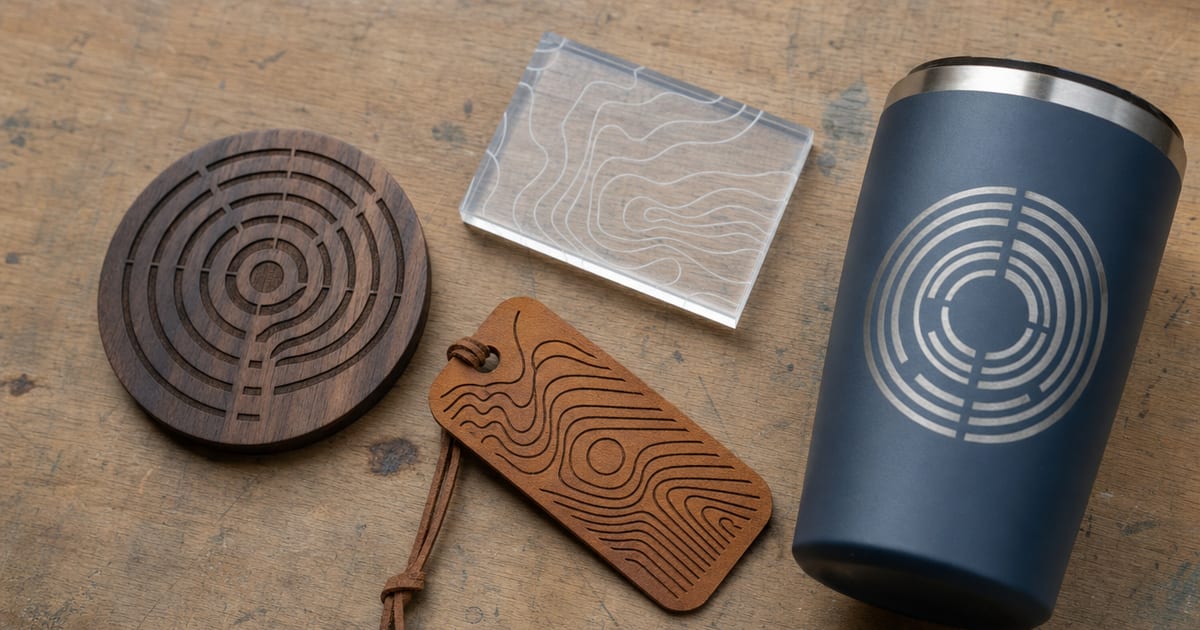
People come into the hobby thinking a laser is one tool that does one thing to everything. It isn’t. Each material has its own personality under the beam — some are a joy, some fight you, and some need a machine you might not own. Here’s the honest material-by-material reality from years at my own bench.
Wood — the friendly one
Wood is where most makers start, and for good reason. It engraves beautifully on both diode and CO2 machines, takes detail well, and the contrast looks great. A few realities worth knowing:
- Density matters. Hardwoods engrave with crisp contrast; soft or resinous woods can scorch or burn unevenly. Test on scrap.
- Grain shows. The laser darkens differently across grain lines, which can be lovely or distracting depending on the piece.
- Air assist makes a big difference on wood — far less scorching and cleaner edges. This is the material where good airflow pays off most visibly.
Wood is the material I’d hand a nervous beginner first.
Acrylic — gorgeous, but mind the type
Acrylic is where the diode-vs-CO2 divide bites hardest.
- CO2 engraves and cuts acrylic beautifully, including clear, with a clean flame-polished edge that looks professional straight off the bed.
- A diode cannot cut clear acrylic at all — the ~450nm beam passes straight through it. (This is literally the mistake that started Cut & Etch.) Diodes can engrave some dark or specially-coated acrylics, but clear acrylic is a CO2 job.
- Cast vs extruded acrylic behaves differently — cast tends to engrave with a nicer frosted white, extruded can engrave clearer. If you’re selling work, learn which you’re buying.
If acrylic is central to what you make, you want a CO2.
Metal — the one that needs the most honesty
Metal is where the most wrong expectations live.
- Bare shiny metal can’t be cut by a hobby diode or CO2 — a diode reflects off it, and a desktop CO2 won’t cut it at hobby power. Cutting metal is fiber-laser territory.
- Marking bare metal also needs help: a diode or CO2 generally needs a marking spray (a coating that bonds to the metal under the beam) to leave a permanent mark on bare metal. Without it, you get little or nothing.
- Coated and anodised metal is different — a diode marks anodised aluminium, painted and powder-coated surfaces well, because it’s interacting with the coating, not the bare metal. Coated tumblers are a popular, very doable diode job.
So “can a laser engrave metal?” depends entirely on whether it’s bare or coated, and whether you’re cutting or marking.
Leather — quietly one of the best
Leather is an underrated joy on a laser, and it’s one of my favourites.
- It engraves with rich, dark detail and cuts cleanly on both diode and CO2 (a capable diode handles real leather goods well).
- Smell and smoke are strong — leather puts out a lot of fume, so this is a material that absolutely demands good extraction ducted outside.
- Vegetable-tanned leather tends to give the best engraving contrast.
Genuine leather is fine; just be sure you know what you’ve got, and run your extraction.
Slate, glass and the other “stone-like” materials
Beyond the big four, a few materials come up constantly and behave in their own way. Slate engraves beautifully on a diode — the beam etches a light, frosted mark into the dark stone, and coasters and signs come out looking premium with very little effort. Glass is trickier: a laser doesn’t cleanly “engrave” glass so much as frost and micro-fracture the surface, which can chip if you push too hard, so light settings and sometimes a damp paper or coating trick give the cleanest result. Neither slate nor glass is cut by a hobby laser — these are surface-marking jobs only. And anodised aluminium deserves a special mention: a diode marks it crisply white by bleaching the anodised layer, no spray needed, which makes it one of the most satisfying “metal” jobs a diode can actually do well.
The material that catches people out: anything coated unknown
A practical warning that spans every material: be careful with stock when you don’t know exactly what it is. Mystery “acrylic” might be polycarbonate, which lasers badly and yellows. A vinyl or PVC layer hidden in a laminate releases toxic gas — never laser PVC or vinyl. A finished or painted surface might give off fumes you didn’t expect. When a material’s composition is unknown, I either find out for certain or don’t put it under the beam. This is as much a safety point as a quality one: the worst material surprises aren’t ugly cuts, they’re harmful fumes. Knowing your material is part of the craft.
The thread through all of it
The pattern, across every material, is the same one this whole site is built on: the material decides what’s possible, the machine type sets the limits, and airflow decides the quality. Match those three and the work gets good fast.
I broke down each material — what cuts, what only engraves, and the optical wattage each needs — in the what lasers cut and engrave by material hub.
These are general observations from my own workshop, not lab tests of any specific machine or material batch. Composition varies — always test on scrap, run proper extraction, and never laser materials (like PVC/vinyl) that release toxic gas.