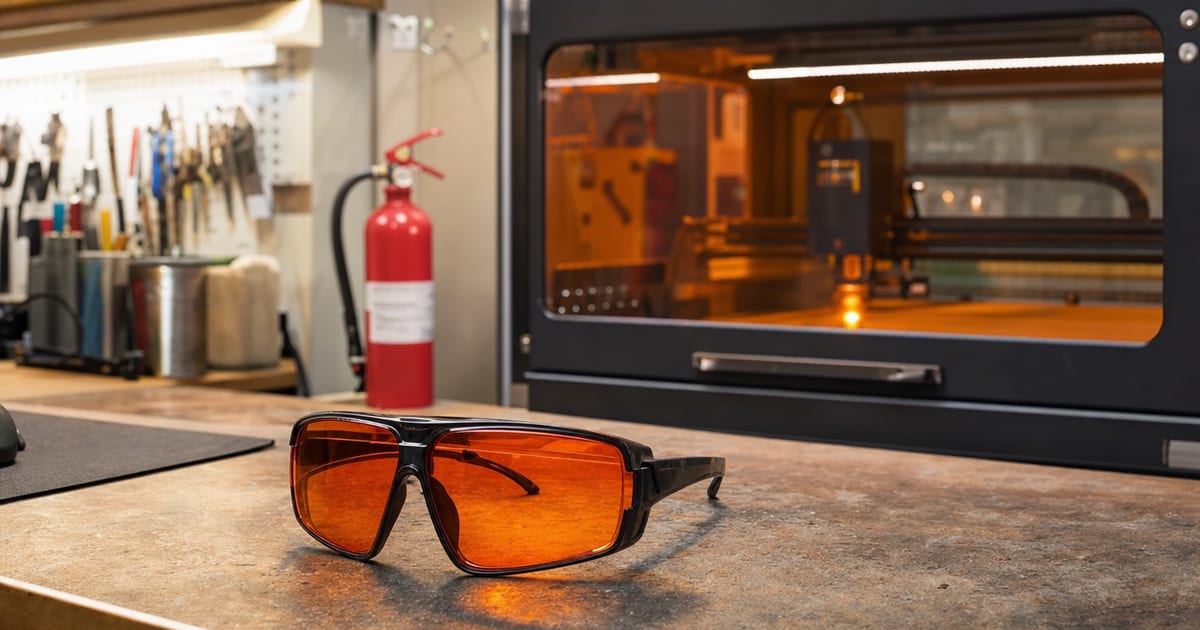
Most of what I write is about getting a clean cut. This post is about the two things I won’t compromise on no matter how routine a job feels: the right eye protection, and never walking away from a running machine. I’m not a safety officer and I won’t pretend to be one — but these two rules are factual, not opinion, and they’re worth being plain about.
Laser glasses are wavelength-specific — this is the part people get wrong
The single most common safety mistake I see is someone grabbing “laser glasses” off a shelf without checking what they’re actually rated for. Here’s the thing that matters: laser safety glasses are specific to a wavelength range and an optical density.
- Wavelength — a diode runs around 450nm (blue), a CO2 runs around 10.6µm (far infrared). Glasses that protect against one do not necessarily protect against the other. You need glasses rated for your machine’s wavelength.
- Optical density (OD) — this is how much the glasses attenuate that wavelength. Higher OD means more protection. The right OD depends on your machine; the manufacturer’s guidance is what to follow.
Ordinary tinted sunglasses or shop goggles do not protect your eyes from laser light. They make the room look darker while letting the dangerous wavelength through. Only glasses correctly rated for your machine’s wavelength and optical density do the job. This is the one place I’d never economise.
A note on enclosed machines: many desktop CO2 lasers have a lid with a window designed to filter their wavelength, so you may not need to wear glasses while the lid is closed and intact. Open-frame diodes are a different story — the beam is exposed, and rated glasses matter every time it’s running. Either way, follow what your machine’s manufacturer specifies.
The fire watch is not negotiable
The second rule is simpler to state and just as important: never leave a running laser unattended.
A laser is a focused beam concentrating heat onto flammable material — wood, paper, acrylic, leather. Flare-ups happen, especially on cuts and especially without good air assist. If you’re in the room, a flare-up is a minor moment you deal with in seconds. If you’ve stepped out to make a coffee, it’s how workshop fires start. Air assist reduces flare-ups; it does not remove the risk. Stay with the machine the entire time it runs, and keep a way to cut power and a means of dealing with a small fire within reach.
Why “it’s just a quick job” is the dangerous mindset
The mistakes I worry about most aren’t the dramatic ones — they’re the small lapses on routine jobs. Nobody skips their glasses or steps away during their first nervous cut. It’s three months in, on the hundredth keychain, when the machine feels like an appliance and the job is “only two minutes,” that the corner gets cut. That’s exactly when a flare-up catches a distracted maker out, or a stray reflection finds an unprotected eye. I keep my glasses on the bench next to the machine, not in a drawer, so reaching for them is automatic. And I treat “it’s a quick job” as the specific signal to be more careful, not less — because that’s the mindset that precedes most of the close calls I’ve heard about. Routine is where complacency lives.
A word on reflections and bystanders
Two extra factors people forget. First, reflections: a diode beam bouncing off a shiny workpiece, a metal clamp or a polished bed can send laser light in directions you didn’t expect, which is part of why rated glasses matter even when you’re not looking straight at the head. Keep reflective objects out of the beam path where you can. Second, bystanders: if someone wanders into the room while you’re running an open-frame laser — a kid, a partner, a curious friend — they have no eye protection and don’t know to look away. I don’t run my open-frame diode when others are in the room without glasses, and I keep pets out entirely. The fire watch isn’t only about the machine; it’s about who and what is around it.
The short, honest checklist
- Wear laser glasses rated for your machine’s specific wavelength and optical density — not generic tinted eyewear.
- For enclosed machines, keep the lid closed and the protective window intact; follow the manufacturer on whether glasses are also required.
- Run proper fume extraction ducted outside — laser smoke is harmful to breathe.
- Never cut materials that release toxic gas, such as PVC or vinyl.
- Never leave a running laser unattended — keep a fire watch the whole time.
- When in doubt, follow your machine’s manufacturer instructions over anything you read online, including me.
Keep a way to stop, and a way to fight a small fire
Two pieces of the fire watch are easy to overlook. The first is knowing how to kill the job instantly — where the emergency stop or power cutoff is, without having to think about it. In a flare-up, seconds matter, and fumbling for the right switch is exactly the wrong time to learn its location. The second is having a means to deal with a small fire within reach — appropriate for an electrical/workshop setting and the materials you cut. I’m not going to play fire-safety expert here; the point is simply that “stay with the machine” only helps if you can actually act when something happens. A fire watch where you’d just stand and panic isn’t really a fire watch. Think through, before you ever need it, what you’d do in the first ten seconds of a flare-up.
None of this is meant to scare anyone off the hobby — I love it, and it’s safe when you respect the machine. It’s meant to keep your eyes and your home intact while you make things you’re proud of.
The correctly rated glasses, extraction and the rest of the safety kit are covered in the laser safety and accessories hub.
This is factual safety information drawn from established laser-safety guidance, not a substitute for your machine’s manual or for professional advice. Always follow the manufacturer’s instructions for your specific machine.