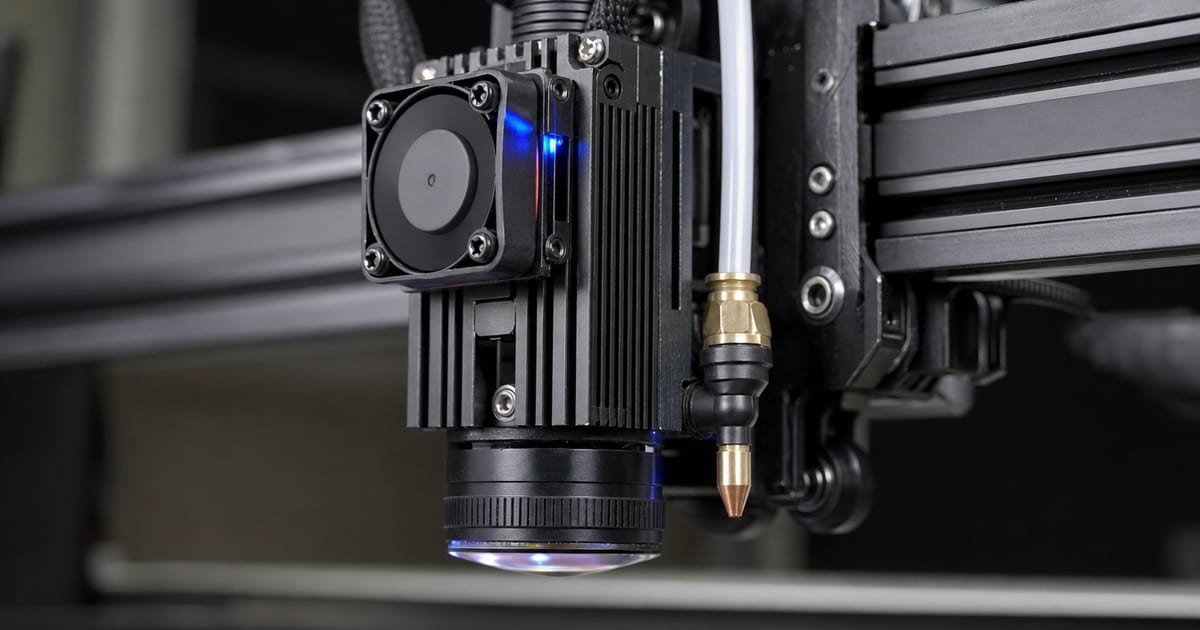
If there’s one number that costs first-time buyers more money than any other, it’s the wattage on the box. I fell for it on my first laser, and I see makers at my local makerspace fall for it constantly. The fix is simple once you know it, so let me lay it out the way I wish someone had laid it out for me.
Two different “watts” wear the same label
When a laser is described as a certain number of watts, that figure can mean one of two very different things:
- Input (electrical) wattage — how much power the whole unit pulls from the wall outlet. This is a big number that includes everything: the laser diode, the cooling, the electronics, the losses.
- Optical (output) wattage — how much actual laser light reaches your material. This is the number that determines whether you can cut or only engrave, and how thick you can go.
The gap between them is enormous. A diode module’s optical output is only a slice of what it draws, because a lot of the input power becomes heat, not beam. So a machine truthfully advertised by its input draw can show a headline number several times larger than the optical power you’ll ever put on a workpiece.
Why the trick works on us
There’s nothing illegal about quoting input power — it’s a real spec. The problem is that buyers assume “watts” means cutting power, and a bigger number feels like a better machine. So a listing that leads with input wattage looks far more capable than one that honestly states a modest optical figure, even when the honest machine is the stronger cutter. I bought the impressive-looking number and got a machine that couldn’t do the job I bought it for.
How I read a spec sheet now
These are the habits that keep me from overpaying for power I’ll never see:
- Hunt for the word “optical.” A reputable spec sheet states the optical output power explicitly — often something like “10W optical output.” If the listing only shouts a big bare “watt” number with no mention of optical output, treat that number as input power until proven otherwise.
- Be suspicious of round, giant headline numbers on budget machines. Real-world hobby diode modules cluster around a handful of optical tiers — roughly 5W, 10W, 20W and 40W optical. A headline figure far above those tiers, on a cheap machine, is almost always the input draw.
- Match the tier to the job, not the number to your ego. A genuine 20W optical diode is a capable wood and leather machine. A “huge-watt” diode that turns out to be a few watts optical is not, regardless of how the box reads.
- Read the laser type first, watts second. Wattage only means something within a laser type. A diode and a CO2 laser at the same optical wattage cut completely different materials, because the wavelengths interact with materials differently.
A quick way to sanity-check a listing
When I’m helping someone at the makerspace size up a machine they’re tempted by, I run a few quick checks that flush out an inflated number fast:
- Does the spec say “optical output” anywhere? If yes, trust that figure and ignore the headline. If the listing carefully avoids the word “optical” and only shouts a big bare number, assume it’s input power.
- Is the headline number wildly above the common optical tiers (5/10/20/40W) for a budget machine? A cheap diode claiming a huge number is almost certainly quoting the wall draw.
- What does the cut chart actually show? A reputable seller publishes what the machine cuts and engraves at what speeds. If a “huge-watt” machine’s own cut chart shows it struggling with thin plywood, the headline number is marketing, and the cut chart is the truth.
- Does the price match the claim? Genuine high-optical-wattage modules cost real money. A suspiciously cheap machine with a giant watt number is the classic input-wattage tell.
None of these require any special knowledge — they’re just the habit of reading past the headline.
It’s not only diodes
Worth knowing: this matters most with cheap diodes, but the principle applies everywhere. With CO2 lasers the headline figure is usually closer to the real optical tube wattage, but tube ratings can still be optimistic, and a tube degrades over its life so an older tube delivers less than its sticker. The lesson generalises: the number that matters is the power that reaches your material, and the only way to know it is to read the optical spec and the cut chart, not the biggest figure on the page.
The number that actually matters
Once I started reading optical wattage instead of headline wattage, buying got honest. I could look at a material and a thickness and know roughly what tier I needed, then shop for a machine that genuinely delivered it. No more guessing, no more “why won’t this cut.”
I broke down what each diode tier actually does — and what the inflated numbers are hiding — in the diode laser engravers explained by wattage hub. If you only take one thing from this post, take this: find the optical output figure before you find the price.
This is general buying guidance from my own experience, not lab testing of any specific machine. Always check the manufacturer’s stated specs and follow their instructions.