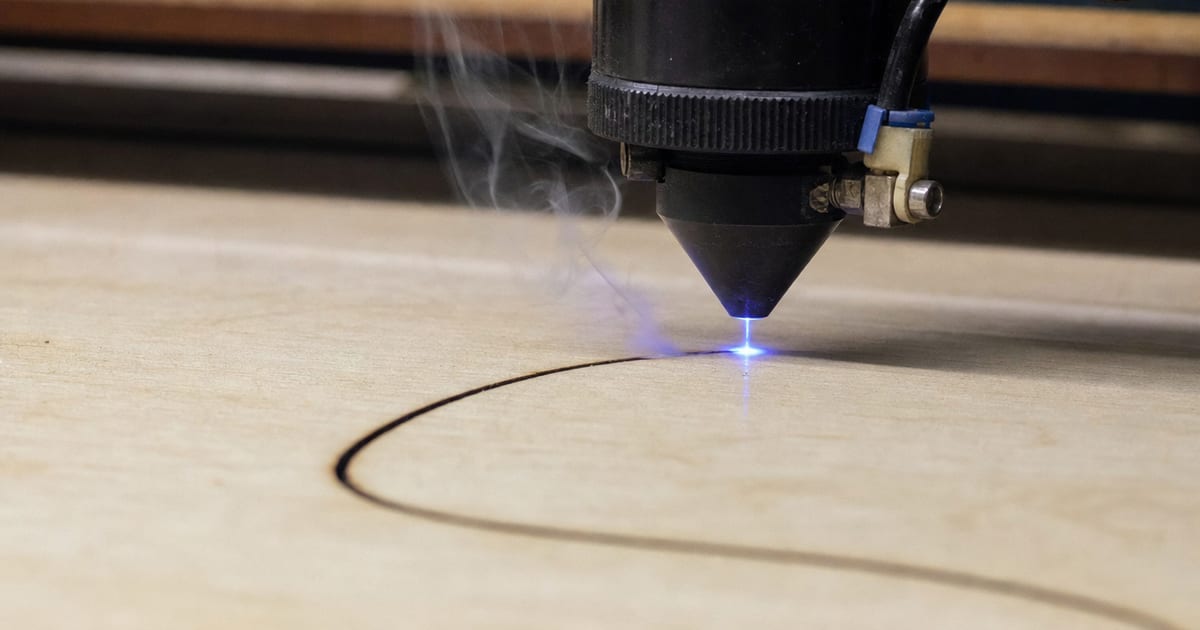
“Will a 20W diode cut what I want?” is probably the most common question I get, and it’s a good one — because the answer is genuinely useful once you’re talking in optical watts and not the inflated box number. Everything below assumes optical (output) wattage, the power that actually reaches the material. If you’re not sure which number you’re looking at, that distinction is the whole game.
The tiers, in plain materials
Here’s how the common optical tiers shake out in real work, from years of running a mid-wattage diode and comparing notes with other makers.
5W optical — an engraver, barely a cutter
A 5W optical diode is an engraving machine. It marks wood, leather and coated items nicely, and with patience it’ll cut very thin material like paper, card, thin veneer and thin leather. Ask it to cut structural wood and you’ll be there all night across many passes for a mediocre edge. Treat 5W as “engrave anything suitable, cut only the thinnest stuff.”
10W optical — the comfortable engraver, light cutter
A 10W optical diode is the sweet spot for a lot of hobbyists who mostly engrave. It engraves faster and darker than 5W and will cut thin plywood and thin hardwood (think a few millimetres) in a sensible number of passes. Still not a thick-material cutter, but a genuinely useful all-rounder.
20W optical — the workhorse cutter for thinner stock
A 20W optical diode is where cutting becomes practical for craft work. It cuts plywood and hardwood in the low-to-mid single-digit millimetre range without an absurd pass count, cuts leather well, and engraves fast. This is the tier I point most serious hobbyists toward if they want one machine that both engraves and cuts real material.
40W optical — the top of the diode ladder
A 40W optical diode pushes into thicker wood and leather and cuts faster, with fewer passes than 20W on the same stock. It’s the most capable diode tier for cutting — but note that “more diode watts” never changes the wavelength limits. Even 40W of diode will not cut clear acrylic or bare metal, because that’s a wavelength problem, not a power problem.
The two limits no diode wattage fixes
This is the part people miss when they assume a bigger diode solves everything:
- Clear acrylic — transparent to the ~450nm diode wavelength. No diode tier cuts it. That’s a CO2 job.
- Bare metal — reflects the diode beam. No diode tier cuts it, and marking bare metal needs a marking spray or a fiber laser.
More watts means faster cutting and thicker organic stock — it does not unlock materials the wavelength can’t touch.
Why passes matter as much as watts
One thing the wattage tiers don’t capture on their own is the role of passes. A diode cuts by removing material a little at a time, and on anything but the thinnest stock it doesn’t punch through in a single sweep. So a 20W diode cutting 5mm plywood isn’t doing it in one pass — it’s making several passes, each one deepening the kerf, until it cuts through. This is why “can it cut X?” always has a hidden second question: “in how many passes, and am I willing to wait?” A higher tier cuts the same material in fewer passes, which is really what you’re paying for — speed and patience, not magic. When I quote a thickness a tier can cut, I’m assuming a sensible pass count, not one heroic pass. If you find yourself stacking up ten-plus passes to get through something, that’s the tier telling you it’s near its limit, and a step up in optical wattage (or a CO2) will save you a lot of time.
Focus and air assist shift every result
Two things outside the wattage number change what a given tier actually achieves. Focus is the first: a diode cuts best when the beam is focused to a fine point at the right height on your material, and a sloppy focus spreads the energy and weakens the cut as surely as dropping a wattage tier. The second is air assist — blowing air across the cut clears smoke from the beam path and keeps the laser cutting at full strength instead of fighting its own plume. A well-focused 20W diode with good air assist will out-cut a poorly-set-up one every time, sometimes by a tier’s worth of capability. So when you read “a 20W cuts 6mm ply,” read it as “a properly focused 20W with air assist,” because that’s the condition those numbers assume.
How to pick your tier
- Mostly engraving wood, leather and coated items? 10W is plenty.
- Want to both engrave and cut real craft stock in one machine? 20W is the practical answer.
- Cutting thicker wood and leather regularly and want speed? 40W.
- Need to cut acrylic or metal? No diode tier — that’s a different machine type entirely.
I matched specific machines to each of these tiers in the best diode laser engravers by wattage guide, with the optical figures stated up front so you’re comparing like for like.
These are general capability ranges from my own experience and published cut behaviour, not bench tests of any specific machine. Wood density, focus and air assist all shift real results — always test on scrap and follow your machine’s guidance.